
.webp)
If you’ve ever walked through a spinning mill at 6 AM, you know the sound: a low, rhythmic hum broken only by the sharp slap of a loose apron or the hiss of pneumatic strippers. Textile mills are tough on equipment. You’re pushing thousands of pounds of raw fiber, sticky waxes, and corrosive dyes through tight tolerances every single day.
Standard flat PVC belts just don’t hold up here. They slip under heavy cotton bales, build up static like crazy, and turn into a total nightmare on inclines. That’s why we use lattice belts.
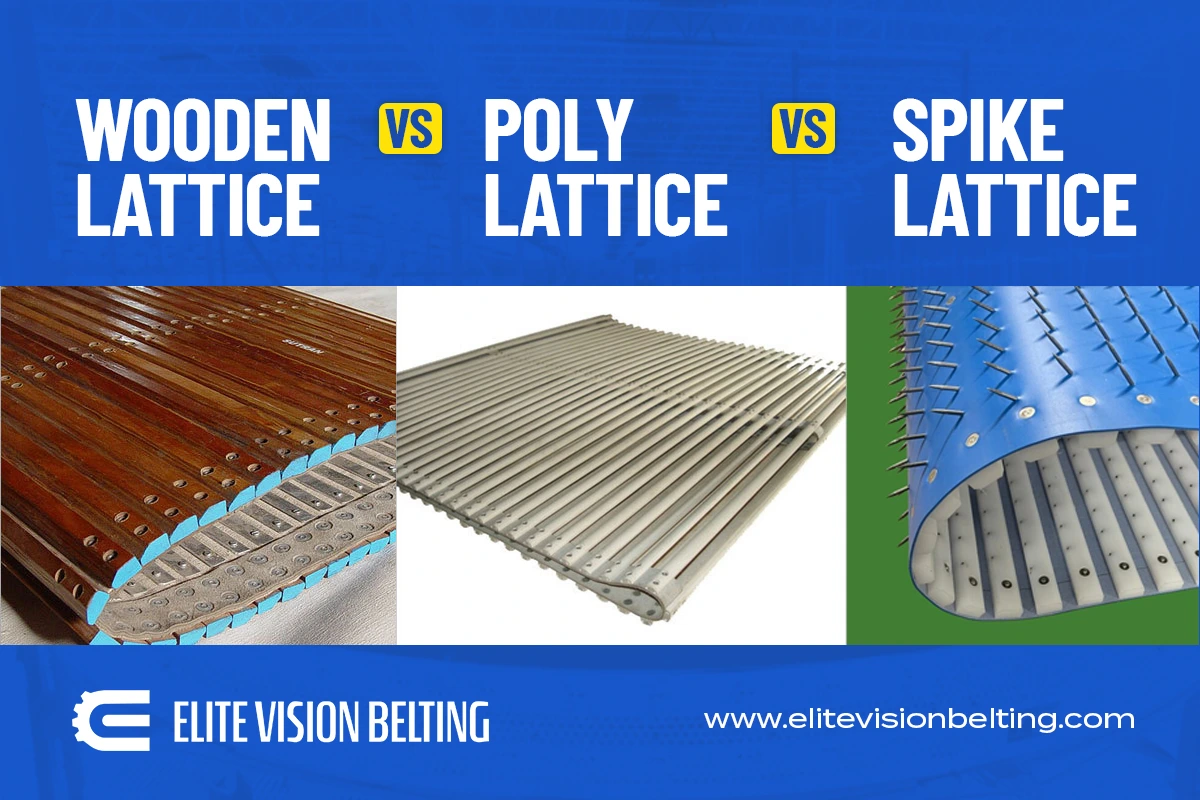
Basically, a lattice belt is a set of parallel slatted bars bolted onto heavy-duty backing straps or drive chains. The gaps let dirt and short waste fibers drop right through instead of clogging up your machinery, and the positive drive keeps everything tracking straight even when the load gets uneven. But choosing between Wooden Lattice, Poly Lattice, and Spike (Pinned) Lattice isn't always obvious. Get it wrong, and you’re looking at constant downtime, broken pins, or ruined batches.
Wooden Lattice: Old School Strength for Heavy Bulk
Wooden lattice belts are the classic workhorses. We’re talking dense, seasoned hardwood slats—usually teak, oak, or high-density beech—mounted onto thick canvas, rubber, or leather backing strips.
Why They Work
- They take a beating: When a heavy 200 kg bale of raw fiber gets dropped onto a feed apron, hardwood doesn't snap. It absorbs the impact and keeps moving.
- Rigidity across wide spans: On extra-wide feed hoppers (1.5 meters or more), plastic slats can bow in the middle under heavy weight. Good teak slats stay rigid.
- Cheaper upfront: If you're running a dry blowroom setup, wood gives you great mechanical life without breaking the bank.
Where They Fail
Wood is porous. Period. If you expose a wooden lattice to high humidity, scouring liquor, or wet finishing chemicals, the slats absorb water, swell up, warp out of shape, and eventually split or rot. Keep wood far away from wet processing.
Poly Lattice: Clean, Flexible, and Waterproof
Poly lattice belts swap out hardwood for extruded Polyurethane (PU) or PVC slats, usually fitted onto synthetic backing belts or modular plastic links.
Why They Work
- Zero rot, zero absorption: Water, oils, print pastes, chemical dyes—poly slats don't care. You can hose them down all day long during color changes without ruining the material.
- No splinters, no snagging: Smooth plastic won't catch delicate synthetic filaments or leave tiny wood splinters in your carded sliver.
- Lighter on your motors: Poly is much lighter than hardwood. That lower mass means less strain on your gearboxes and lower power draw over long production runs.
Where They Fail
Under extreme heat or heavy single-point impacts, cheaper poly slats can sag or flex if they aren't thick enough for the conveyor span. Make sure your slat thickness matches your hopper width.
Spike (Pinned) Lattice: Unforgiving Grip for Steep Inclines & Fiber Opening
Spike lattices (or pinned aprons) take wooden or poly slats and drive steel pins right through them at specific angles.
Why They Work
- Aggressive grab: When you need to pull matted, tangled raw wool or cotton up an 80-degree incline feeder, flat slats won't do it. Steel pins dig straight into the bulk material and drag it up.
- Active fiber opening: As the spiked apron rotates past an opposing evener comb or stripper roller, the pins actively pull the fiber clumps apart, tufting and opening the material before it hits the carding set.
Where They Fail
They're high-maintenance. If a stray bolt or piece of metal scrap sneaks into your raw fiber hopper, it’s going to bend or shear off a row of pins. You have to keep a close eye on clearance settings and inspect your pin arrays regularly.
Quick Comparison
|
Metric |
Wooden Lattice |
Poly Lattice |
Spike (Pinned) Lattice |
|
Slat Material |
Hardwood (Teak/Beech) |
Extruded PU / PVC |
Wood or Poly Base + Steel Pins |
|
Water & Chemical Resistance |
Terrible (Warping & rot) |
Outstanding (100% waterproof) |
Depends on the base slat material |
|
Grip on Bulk Fiber |
Moderate (Friction only) |
Moderate (Smooth/Textured) |
Unbeatable (Mechanical pin penetration) |
|
Fiber Opening Action |
None (Conveying only) |
None (Conveying only) |
Active opening & tufting |
|
Weight / Energy Use |
Heavy / Higher load |
Lightweight / Energy efficient |
Moderate to Heavy |
|
Maintenance Needs |
Low-to-Moderate |
Very Low |
High (Pin inspection & alignment) |
|
Best Budget Fit |
Low upfront cost |
Mid-range (Long service life) |
Premium (Custom pin layouts) |
Which One Should You Actually Put in Your Mill?
1. Spinning Lines (Cotton & Synthetics)
- Blowroom Hopper Feeders: Go with a Spike Lattice. You need those steel pins to grab matted raw cotton out of the hopper and open up the tufts before feeding the line.
- Card Feed Aprons: Use a Poly Lattice. It’s smooth, static-free, and won't drop wood splinters into your clean cotton webs.
2. Woolen & Worsted Processing
- Scouring & Washing Lines: Poly Lattice, zero debate. Wool grease, hot water, and harsh detergents will destroy a wooden belt in weeks.
- Wool Blending & Bale Breaking: Use Wooden or Spike Lattices. Heavy, dense greasy fleeces need the rugged impact absorption of solid hardwood or the aggressive bite of steel pins.
3. Printing & Fabric Finishing
- Washer Returns & Print Table Feeders: Poly Lattice only. Print pastes, reactive dyes, steam, and water jets make synthetic belts the only sensible choice here.
FAQs
FAQ 1: How do I tell when my lattice belt needs to be pulled?
Watch the backing belt. If the canvas or rubber tracking strips start stretching unevenly or fraying at the edges, your slats will start twisting out of square. On spiked aprons, if you notice bent or missing pins causing uneven fiber feeding across the width, it's time for a refurbish.
FAQ 2: Can I swap out my old wooden lattice for a poly one without changing the drive?
In almost every case, yes. As long as we match the original slat pitch, width, and height to engage your existing drive sprockets, a poly lattice drops right into the same frame.
FAQ 3: How do I pick the right pin density for a spike apron?
It comes down to staple length. Short, dense cotton fibers need a tighter pin arrangement with shorter pins so the material doesn't choke. Long-staple wool or synthetic fibers need wider pin spacing and steeper pin angles to pull the fleece cleanly without jamming.
Upgrade Your Textile Lines with Elite Vision Belting
A failed belt at 2 AM on a Tuesday isn't just an annoyance—it's thousands of rupees in lost production while your operators stand around waiting for repairs.
At Elite Vision Belting, we build custom Wooden Lattices, Poly Lattices, and Pinned Spike Lattices engineered specifically for the exact pitch, width, and operating conditions of your mill.
Head over to Elite Vision Belting or give our tech team a direct call at +91 931-761-3193 to talk specs or get a quick quote.
